How to Verify a Curaçao Casino Licence in 2026
· Editorial team
Check a Curaçao Gaming Authority licence step by step: OGL number, validation seal, licensed company, red flags from the 2026 leak, and the Ontario comparison.
Verifying a Curaçao casino licence used to take thirty seconds: click the seal in the footer, see a green "validated" page, move on. After the September 2026 leak of the Curaçao Gaming Authority's licensing files, that check still tells you a licence exists. It no longer tells you much about who is behind it or how carefully it was granted. This guide explains what a Curaçao licence is in 2026, how to check one properly, what the leaked assessor notes revealed about the process, and how the licence compares with the alternatives a Canadian player actually has. Nothing here requires an account or a tool; it is a footer, a register and ten minutes.
What a Curaçao licence is (and is not) in 2026
Until 2024, Curaçao ran a two-tier system: four "master licence" holders, private companies, issued sub-licences to thousands of operators with almost no public oversight. The National Ordinance on Games of Chance (LOK), passed in 2024, replaced that with direct licensing by a new regulator, the Curaçao Gaming Authority (CGA). Every operator now needs its own licence, numbered in the format OGL/YYYY/NNNN/NNNN, and pays an annual fee. According to the researcher who accessed the regulator's portal, the system held around 550 active licences at roughly EUR 47,450 a year and about 8,200 registered casino domains at the time of the breach; the CGA has not confirmed those figures.
Two things a Curaçao licence does not do, and never has: it does not authorise gambling in Curaçao itself, and it is not recognised as a domestic licence by Canada, the United States, the United Kingdom, Germany or almost any other country. The consortium behind the leak put it bluntly: the licences "have not been officially recognized by almost any other government in the world." In Canadian terms, a Curaçao-licensed casino is an offshore site. Outside Ontario and Alberta that is the normal state of affairs; inside those two provinces it means the site is not allowed to take you as a customer.
Reading a licence number
A post-2024 licence line in a casino footer looks like this: "Licensed and regulated by the Curaçao Gaming Authority, licence OGL/2024/1451/0918, issued to Medium Rare N.V." (that example is Stake's, as reported in coverage of its Canadian availability). The parts:
- OGL: Online Gaming Licence under the LOK.
- Year: year of issue. A 2024 or 2025 number means the operator went through the new process; anything older, or a number in the old format (for example 8048/JAZ or 1668/JAZ), is a legacy sub-licence that should have been converted by now.
- Two numeric blocks: the licence sequence and an internal reference.
- Legal entity: an N.V. or B.V. registered in Curaçao. This is the company you contract with. It is frequently not the company that runs the business day to day, which is exactly the gap the leak exposed.
If the footer shows a seal but no number, or a number but no company, treat the licence as unverified until you find both.
Step-by-step verification
Step 1: find the licence line and the seal
Scroll to the footer. Look for the licence number, the company name and a clickable validation seal. Note all three. If the seal image is not a link, right-click it: a genuine seal opens a validation page on the regulator's or its validator's domain, not a page on the casino's own domain.
Step 2: check the validation page matches the site you are on
The validation page shows the licence number, the licensed company and the domain the licence covers. The domain listed must be the domain you are on. Operators run many mirror domains; a licence for casino-one.com does not cover casino-one-mirror.net unless the mirror is listed. This is the most common way a fake or borrowed seal gets caught.
Step 3: cross-check the company
Search the company name (Medium Rare N.V., Caecus N.V. and so on) together with the brand. Since 22 September 2026 the fastest cross-check is the #CasinoSecrets reporting itself: the consortium's site has a search box for companies and domains, and Follow the Money's investigation names the licensed entities behind the largest brands. If the company on your casino's footer is not the company the regulator licensed for that brand, ask support to explain the difference in writing.
Step 4: read the terms for the governing law and dispute route
The terms should name the same Curaçao company, state that Curaçao law governs, and name an alternative dispute resolution provider. The leaked assessor notes include at least one case where the suitability team flagged that the ADR provider chosen by an applicant was affiliated with the applicant and therefore "likely to be unfair." An ADR that is a subsidiary of the operator is not a dispute route.
Step 5: check the operator behaves like a licensed one
Licence conditions under the LOK include KYC before withdrawal, responsible gambling tools and a complaints procedure. If a site lets you deposit and play with no verification at all, or has no self-exclusion option, the licence is not being applied regardless of what the footer says. Our how we test page lists the checks we run before a casino makes our list; the licence check is the first of them.
What the leak changed about the check
Before September 2026 the honest answer to "is a Curaçao licence worth anything?" was "it depends on the operator, and you cannot see the file." Now large parts of the file are described in public reporting, and the picture is uneven.
On the positive side, the CGA did run assessments. The consortium's stories quote assessors identifying missing source-of-wealth documents, questioning whether declared owners were the real owners, and noting that applicants lacked the funds to plausibly own their companies. Questions were asked about Stake's ownership after payments to companies connected to its founders; questions were asked about 1xBet's declared owner and his ties to the brand's publicly reported founders. The regulator was not blind.
On the negative side, according to FTM, licences were granted anyway: assessors "accepted incomplete responses," ownership questions were left unresolved, and warnings from foreign regulators about blacklisted operators were not always acted on. The researcher's write-up adds that suitability work was largely outsourced to two private consultancies, one in Malta and one in Cyprus, and that in at least one case a consultancy director marked licences as issued directly.
The CGA's response, on 23 September, is that separate documents do not represent the full context of an application and that the sector reform which began in 2024 is ongoing. Both things can be true. For a player the practical lesson is narrow: a valid Curaçao licence tells you a company exists and paid a fee; it does not tell you the ownership was verified. You have to do that part yourself, and for the first time you have public reporting to do it with.
Red flags that a licence page will not show you
| Red flag | Why it matters | How to check in five minutes |
|---|---|---|
| Company on the footer differs from the company in the terms | You may not know which entity holds your money | Compare the footer, the terms and the validation page; all three should match |
| Licence issued in 2024 or 2025 to a company registered weeks earlier | Shell set up for the application; ownership likely sits elsewhere | Search the N.V. name; recent incorporation with no history is the tell |
| ADR provider owned by or affiliated with the operator | No independent dispute route | Search the ADR name plus "affiliate" or the operator's group name |
| Site accepts Ontario or Alberta players without a provincial licence | Operating illegally in a regulated province; withdrawals there can be frozen by payment blocks | Check the AGCO/iGO and AGLC registrant lists; if the brand is absent, it is unlicensed there |
| Footer licence changed recently (new number, new company, new regulator) | Operator moved, often after questions about the previous licence | Compare with an archived copy of the page; note the date of the change |
| Brand named in #CasinoSecrets reporting with unresolved ownership questions | Regulator itself doubted the file | Search the brand on the consortium's site and in FTM's story |
| No KYC before withdrawal, no deposit limits, no self-exclusion | Licence conditions not applied; likely no compliance function at all | Look for the responsible gambling page and the account limits menu |
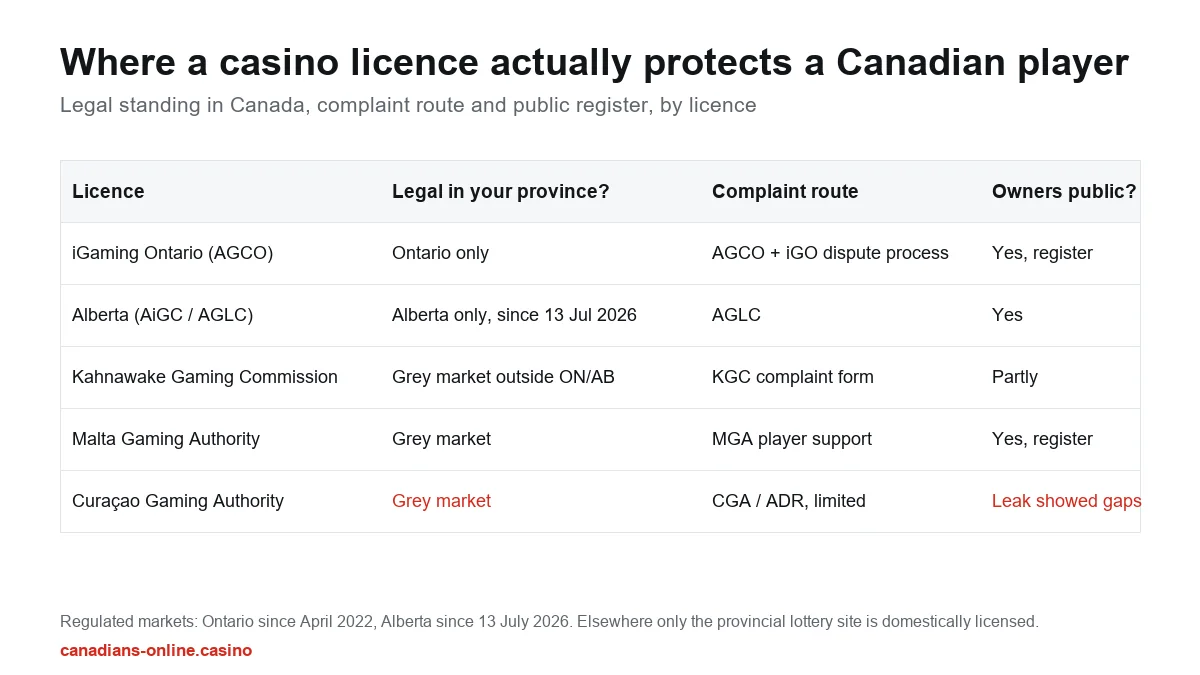
Curaçao versus the licences that matter in Canada
| Licence | Legal standing in Canada | Public owner information | Complaint route | Player protections required |
|---|---|---|---|---|
| iGaming Ontario (AGCO registration) | Fully legal in Ontario only | Registrant search on AGCO site | AGCO complaint process, iGO oversight | Segregated player funds, mandatory limits, advertising rules (no public bonus ads) |
| Alberta iGaming Corporation (AGLC licence, since 13 July 2026) | Fully legal in Alberta only | AGLC licensee list | AGLC | Modelled on Ontario |
| Provincial lottery sites (PlayNow, Espacejeux, Atlantic Lottery, Play Alberta) | Fully legal in their province | Crown corporation | Provincial ombudsman routes | Full |
| Kahnawake Gaming Commission | Grey market outside Ontario and Alberta | Partial | KGC complaint form; historically responsive | KYC, dispute process |
| Malta Gaming Authority | Grey market | Licensee register public; MGA files also breached in March 2026 | MGA player support unit | Segregated funds, ADR, strong on paper |
| Curaçao Gaming Authority | Grey market | Register shows company, not owners; leak showed ownership checks were often incomplete | ADR named in terms; CGA complaints portal, limited | KYC, RG tools under the LOK; enforcement uneven |
| Anjouan, Tobique, other small jurisdictions | Grey market | Minimal | Minimal | Minimal |
The gap between the first three rows and the rest is the gap between a licence that gives you a Canadian regulator and a licence that does not. A Malta or Curaçao licence can still belong to an honest operator; it just means the honesty is the operator's choice rather than a requirement someone in Canada can enforce.
Which licence you should expect, by province
- Ontario: iGaming Ontario registration, nothing else. A Curaçao-licensed site taking Ontario players is operating illegally there; large operators have withdrawn from the province rather than risk it. If your site is Curaçao-licensed and still serves you in Ontario, that is a red flag about the operator, not a loophole for you.
- Alberta: since 13 July 2026, an AGLC licence. The market is new and some offshore sites still accept Alberta players; expect that to tighten over the coming year as it did in Ontario.
- British Columbia, Manitoba, Saskatchewan, Quebec, Atlantic Canada: the provincial lottery site is the only domestically licensed option. Any other casino is offshore, and Curaçao is the most common licence you will see. Verify it with the five steps above, and give weight to Kahnawake or Malta where the choice exists.
Our list of the best online casino sites in Canada for real money shows the licence of every operator we recommend and the date we last verified it. Payment methods and payout timings for each are on the payments page.
Sources
- Follow the Money: Curaçao's secretive gambling industry exposed in leak (22 September 2026)
- Lilith Wittmann: Casinolizenzen aus Curaçao (22 September 2026)
- Curaçao Chronicle: CGA defends licensing process (23 September 2026)
- AGCO: marketing and advertising standards for iGaming
- Government of Alberta: Alberta's iGaming Strategy
The short version
A Curaçao casino licence in 2026 is verifiable in minutes: footer, seal, validation page, company name, terms. What the September leak added is context. The regulator asked the right questions of applicants and, according to the reporting, often licensed them without getting answers. So treat the licence as the start of the check, not the end: confirm the company matches across footer, terms and validation page, look the brand up in the published reporting, and if you live in Ontario or Alberta, use a provincially licensed site instead. We re-verify every licence on our list monthly and note the date on each review.
About the editorial team. Our editorial team tests online casinos for Canadian players and helps them when a payout goes missing. Every casino listed on this site has been signed up for, deposited to and cashed out of with our own money. Corrections and reader experiences: see our about page.
Frequently asked questions
How do I check if a Curaçao casino licence is real?
Find the licence number and company in the footer, click the validation seal and confirm the page is on the regulator's or validator's domain, check that the domain you are on is listed, and confirm the same company appears in the terms. If any of the three differ, ask support in writing.
What does an OGL licence number look like?
Post-2024 licences use the format OGL/YYYY/NNNN/NNNN, for example OGL/2024/1451/0918, followed by the licensed N.V. or B.V. company. Old-format numbers such as 8048/JAZ are legacy sub-licences from the pre-reform system.
Is a Curaçao licence valid in Canada?
It is not a Canadian licence. Outside Ontario and Alberta it is tolerated as a grey-market licence; in those two provinces only iGaming Ontario or AGLC licensed operators may serve players.
What did the leak reveal about Curaçao licensing?
According to Follow the Money, assessors flagged missing ownership and source-of-wealth information and licences were still granted; much of the suitability work was outsourced to private consultancies. The regulator says isolated documents do not reflect full application files.
Which licence is safest for a Canadian player?
A provincial licence: iGaming Ontario in Ontario, AGLC in Alberta, the lottery corporation sites elsewhere. Among offshore licences, Kahnawake and Malta offer a clearer complaint route than Curaçao.
Can a casino use one licence for several websites?
Yes, but each domain must be listed on the validation page. A licence for one domain does not cover a mirror site unless the mirror appears there.