Is Online Gambling Legal in Canada? 2026 Province Guide
· Editorial team
Is online gambling legal in Canada? Province-by-province rules for 2026: Ontario and Alberta markets, government sites, offshore casinos, ages and tax.
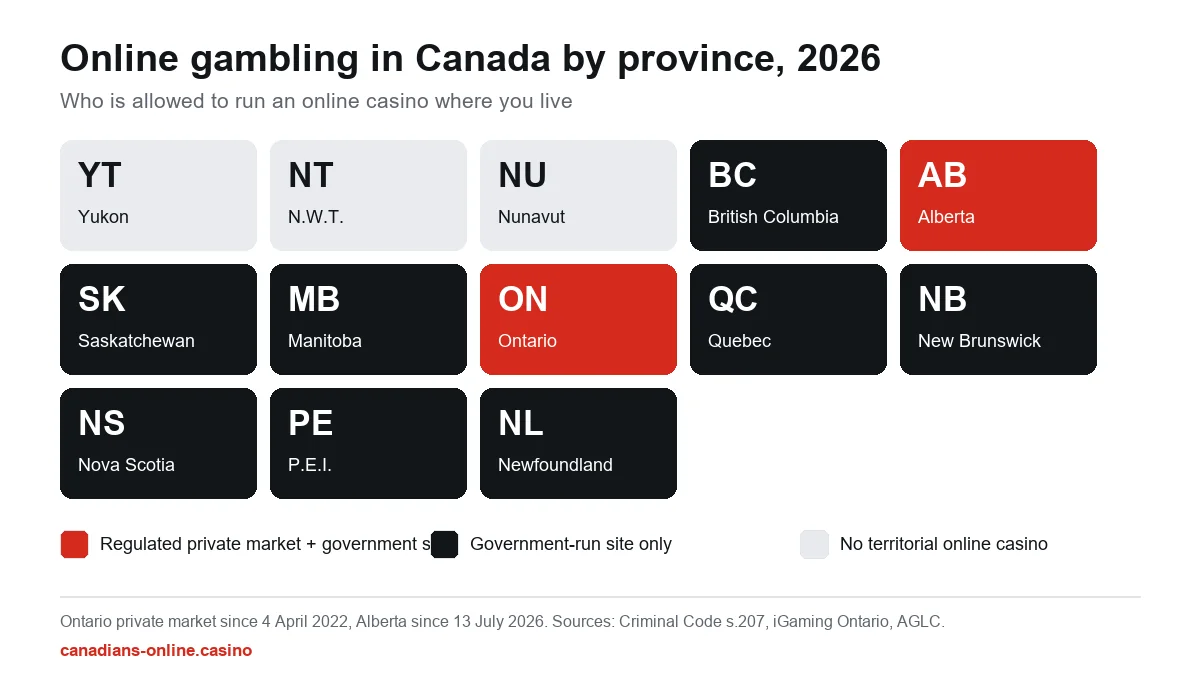
Is online gambling legal in Canada? For the player, in every province and territory, yes. What changes from one province to the next is who is allowed to run the casino, how old you have to be, and whether a Canadian regulator stands behind your balance if a withdrawal goes wrong. Since 13 July 2026 there are two provinces with an open, licensed private market (Ontario and Alberta), eight where the only domestic option is a government-run site, and three territories with no territorial online casino at all. This guide explains the law in plain terms, gives you a province-by-province tool, and shows what each answer means for choosing a real money casino.
The short legal answer: section 207 of the Criminal Code
Gambling in Canada is a federal crime by default and a provincial business by exception. The Criminal Code makes keeping a gaming house, running a lottery and similar activities offences, and then, in section 207, carves out the one big exception that everything else hangs on. Section 207(1)(a) permits "the government of a province, either alone or in conjunction with the government of another province, to conduct and manage a lottery scheme in that province." "Lottery scheme" is the Code's term for almost every form of gambling, including casino games, slots and betting, whether played in a building or through a computer.
Three consequences follow, and they explain nearly every question Canadians ask about online casinos:
- Gambling law is provincial. Each province decides what is offered, by whom, at what age, with what protections. There is no single national online casino licence.
- A private company cannot hold a Canadian casino licence on its own. Ontario and Alberta let private operators in, but the legal structure keeps the province as the body that "conducts and manages" the game: iGaming Ontario in Ontario, the Alberta iGaming Corporation in Alberta. Operators sign an agreement with that body and are registered by the provincial regulator.
- The prohibitions are aimed at operators. The offences are written around running, keeping or profiting from an unauthorised game. Placing a bet from home is not what they target, which is why the practical question for a player is not "can I be charged?" but "who protects my money?"
Check your province
Pick where you are physically located when you play. Location matters, not the address on your ID: a regulated site checks where your device is, and the rules follow that.
Online gambling rules by province
What is legal, the minimum age, and where the licensed options are.
Your province or territory
Ontario licenses private operators through iGaming Ontario, registered by the AGCO. Play on sites that show the iGaming Ontario logo; offshore sites are not permitted to serve Ontario players and bonuses cannot be advertised publicly.
Ages shown are for online casino play. Some provinces set a lower age for lottery products. Rules change; check the provincial regulator before you sign up.
| Province or territory | Who runs licensed online casinos | Private operators allowed? | Minimum age (casino) |
|---|---|---|---|
| Ontario | iGaming Ontario operators, registered by AGCO; OLG's own site | Yes, since 4 April 2022 | 19 |
| Alberta | AGLC-registered operators signed by the Alberta iGaming Corporation; Play Alberta | Yes, since 13 July 2026 | 18 |
| British Columbia | BCLC (PlayNow) | No | 19 |
| Quebec | Loto-Québec | No | 18 |
| Manitoba | PlayNow with Manitoba Liquor and Lotteries | No | 18 |
| Saskatchewan | PlayNow with SIGA and Sask Gaming | No | 19 (18 for lottery) |
| Nova Scotia, New Brunswick, Newfoundland and Labrador, Prince Edward Island | Atlantic Lottery | No | 19 |
| Yukon, Northwest Territories, Nunavut | No territorial online casino; lottery via WCLC | No | 19 |
Ontario: the open market since 2022
Ontario opened Canada's first competitive online gambling market on 4 April 2022. The Alcohol and Gaming Commission of Ontario (AGCO) registers operators and sets the standards; iGaming Ontario (iGO) signs a commercial agreement with each one and is, legally, the body that conducts and manages the games. As of late May 2026, 44 operators were active in the province running more than 75 gaming websites.
The market is large and still growing. Ontarians wagered C$9.46 billion on regulated sites in June 2026 alone, 30.3 percent more than a year earlier, and operators kept C$400.6 million of that as gross gaming revenue. More telling for players is where people play: an Ipsos study published by iGaming Ontario on 21 May 2026 found that 91.1 percent of Ontarians who gambled online did so on regulated sites, up from 83.7 percent a year earlier.
Three rules shape what an Ontario player sees:
- The iGaming Ontario logo is the test. A regulated site displays it; the AGCO tells players to treat it as the sign that the site is conducted and managed by iGO.
- No public bonus advertising. AGCO Standard 2.05 bans operators from advertising bonuses and inducements to the public. Offers appear only on the operator's own site after you sign up. Our guide to casino bonus wagering requirements explains what to check once you see one.
- International liquidity is allowed, for Ontario only. In Reference re iGaming Ontario, 2025 ONCA 770, decided on 11 November 2025, the Ontario Court of Appeal held four to one that Ontario players may share poker tables and betting pools with players outside Canada. The ruling does not cover other provinces.
Alberta: the second open market since July 2026
Alberta passed the iGaming Alberta Act in 2025 and opened its market on 13 July 2026, the second province to license private operators. Alberta Gaming, Liquor and Cannabis (AGLC) registers operators; the Alberta iGaming Corporation handles the commercial side, the role iGO plays in Ontario. Around 22 operator sites went live on launch day, with major brands registered in the weeks before. Play Alberta, the government site, continues alongside them.
The rules follow Ontario closely: operators must integrate with the AGLC's central self-exclusion system, offer financial and time limits from day one, send activity statements, and act when they see signs of problem gambling. The minimum age is 18. For Albertans the practical change is the same one Ontario players got in 2022: a real choice of brands with a Canadian regulator behind them, and a reason to prefer them over offshore sites that still accept Alberta players while the market settles.
Provinces with a government site only
In the other eight provinces the only domestically licensed online casino is the one run by the provincial lottery corporation:
- British Columbia: PlayNow, run by BCLC since 2004, with casino games since 2010. Minimum age 19.
- Manitoba: PlayNow, through a partnership between BCLC and Manitoba Liquor and Lotteries since January 2013. Minimum age 18.
- Saskatchewan: PlayNow, launched in November 2022 and run with the Saskatchewan Indian Gaming Authority and Sask Gaming. Casino 19, lottery 18.
- Quebec: Loto-Québec's online platform, Espacejeux, also available in the Loto-Québec app. Minimum age 18.
- Nova Scotia, New Brunswick, Prince Edward Island, Newfoundland and Labrador: Atlantic Lottery, jointly owned by the four provincial governments. Minimum age 19.
These sites are safe in the sense that matters most: they are government-owned, audited and answerable to a provincial authority. What they rarely offer is breadth. Game libraries are smaller than the large private operators', promotions are modest, and payment options are fewer. That gap is why many players in these provinces also use offshore casinos, and why the next section matters.
Yukon, Northwest Territories and Nunavut
The three territories have no territorial online casino. Lottery products are sold through the Western Canada Lottery Corporation, but casino games, poker and online slots are not offered by any territorial body. Nunavut has not licensed any land-based or online casino at all. In practice every online casino a resident of the territories uses is offshore, which makes the licence checks in the next section the only protection available. The minimum age in all three is 19.
Offshore casinos: what "legal" means for you
An offshore casino is one licensed outside Canada that accepts Canadian players: typically by the Kahnawake Gaming Commission, the Malta Gaming Authority or the Curaçao Gaming Authority. Their legal position depends on who is asking.
- For the operator, the position is untested. Provinces consider unlicensed offshore operators to be operating outside the Criminal Code framework; operators argue they are not operating in Canada at all. No court has settled it for online casinos, and outside Ontario and Alberta there is little active enforcement.
- For the player, the Code's gaming offences are aimed at whoever runs the game. Playing from home at an offshore site is not what they target.
- In Ontario and Alberta, offshore operators are not permitted to serve players. Most major brands chose the provincial licence rather than stay outside, and the ones that remain are the ones with the least to lose.
The Kahnawake Gaming Commission deserves a note because it is Canadian in location if not in law. It was established in 1996 under the Kahnawake Gaming Law enacted by the Mohawk Council of Kahnawake, near Montreal, and has licensed online operators since 1999. The Commission asserts its jurisdiction as an Aboriginal right; provincial governments do not recognise its licences as provincial ones. For a player it offers a complaints route that is closer to home than Malta or Curaçao, which is worth something.
What "offshore" really costs you is recourse. If a withdrawal is refused, there is no Canadian regulator to escalate to; you depend on the foreign licence and the operator's own dispute process. That is why we check the licence on the regulator's own register before a site reaches our list (the steps are in our guide to verifying a Curaçao casino licence), and why we time real withdrawals every month.
Sports betting and single-event bets
Until 2021 the Criminal Code allowed provinces to offer only parlay bets on sports. The Safe and Regulated Sports Betting Act (Bill C-218) removed that restriction and came into force on 27 August 2021, letting provinces offer betting on a single game or event. Every provincial site now offers single-event betting, and in Ontario and Alberta so do the licensed private sportsbooks. Horse racing remains under a separate federal regime.
Do you pay tax on winnings?
For a recreational player, no. The Canada Revenue Agency treats gambling winnings as a windfall, not income, so casino, lottery and sports betting wins are neither reported nor taxed, whether they come from an online casino or a table in Niagara Falls. The flip side is that recreational losses cannot be deducted.
The exception is gambling as a business. If your gambling is organised, consistent and commercial enough that it amounts to carrying on a business (Income Tax Folio S3-F9-C1 sets out the test), profits become business income and are taxable, and losses may become deductible. The threshold is about how you gamble, not how much you win once, and very few players meet it. Interest earned later on winnings is ordinary investment income and is taxed normally.
What this means when you choose a casino
| If you live in | Best first choice | What to check |
|---|---|---|
| Ontario | An iGaming Ontario operator | iGO logo on the site; bonus terms visible only after sign-up |
| Alberta | An AGLC-registered operator or Play Alberta | Operator on the AGLC list; self-exclusion and limits available |
| BC, Quebec, Manitoba, Saskatchewan, Atlantic Canada | The provincial site for safety; a well-licensed offshore site for choice | Licence on the regulator's register; Interac payouts; withdrawal times |
| Yukon, Northwest Territories, Nunavut | A well-licensed offshore site | Licence on the regulator's register; complaints route; small balances |
Wherever you are, four checks separate a casino worth your deposit from one that is not:
- Licence you can verify. Provincial if you are in Ontario or Alberta; otherwise a licence number that appears on the regulator's own site with the same company and domain.
- Canadian payments. Interac e-Transfer for deposits and withdrawals in CA$, with no conversion. Our payments guide compares the options.
- Withdrawal speed you can see. We time real payouts every month; in September the fastest Interac payout on our list arrived in 41 minutes. The results are in our monthly payout check.
- Responsible gambling tools. Deposit limits, time limits and self-exclusion that work from the first day. Our responsible gambling page lists the tools and Canadian support lines, including ConnexOntario at 1-866-531-2600.
Our list of the best online casino sites in Canada for real money applies those four checks to every operator, and explains how we test them with our own deposits.
Sources
- Justice Laws: Criminal Code, section 207
- Canada Gazette: Safe and Regulated Sports Betting Act in force 27 August 2021
- iGaming Ontario: Ipsos channelization study, year 4 (21 May 2026)
- Gambling.com: Ontario handle reaches C$9.46bn in June 2026
- Blakes: Alberta's regulated iGaming market launch date announced (1 April 2026)
- PlayNow.com (BCLC): history and provinces served
- Kahnawake Gaming Commission
- TurboTax Canada: are gambling winnings taxable?
The short version
Online gambling is legal for players everywhere in Canada. Ontario and Alberta license private operators, the other eight provinces run their own sites, and the territories have none, which leaves offshore casinos as the only broad choice for a large part of the country. The minimum age is 18 in Alberta, Manitoba and Quebec and 19 everywhere else for casino play. Winnings are tax-free for recreational players. The question that decides whether a casino is right for you is not legality but recourse: in Ontario and Alberta choose a provincially licensed site, and everywhere else choose an operator whose licence you can verify and whose payouts you can see.
About the editorial team. Our editorial team tests online casinos for Canadian players and helps them when a payout goes missing. Every casino listed on this site has been signed up for, deposited to and cashed out of with our own money. Corrections and reader experiences: see our about page.
Frequently asked questions
Is online gambling legal in Canada?
Yes for players, in every province and territory. Section 207 of the Criminal Code lets each province conduct and manage gambling, so Ontario and Alberta license private operators, the other provinces run government sites, and the territories have no territorial online casino. The Code's gaming offences are aimed at operators, not at players betting from home.
Which provinces allow private online casinos?
Ontario, since 4 April 2022 through iGaming Ontario and the AGCO, and Alberta, since 13 July 2026 through AGLC and the Alberta iGaming Corporation. Everywhere else the only domestically licensed online casino is the provincial lottery corporation's site.
What is the legal gambling age in Canada?
18 in Alberta, Manitoba and Quebec, and 19 in every other province and territory for online casino play. Ontario and Saskatchewan allow lottery at 18 but casino play only at 19. The rule that applies is the one where you are physically located when you play.
Are offshore online casinos legal in Canada?
Their status for the operator is legally untested outside Ontario and Alberta, where unlicensed operators are not permitted to serve players. For the player, the Criminal Code offences target whoever runs the game. The real difference is recourse: an offshore site answers to a foreign regulator, not a Canadian one.
Do I pay tax on online casino winnings in Canada?
Not as a recreational player. The Canada Revenue Agency treats gambling winnings as a windfall. Only gambling carried on as a business produces taxable income, and interest later earned on winnings is taxable as ordinary investment income.
Is sports betting on single games legal in Canada?
Yes. The Safe and Regulated Sports Betting Act came into force on 27 August 2021 and allowed provinces to offer betting on single events. It is available on every provincial site and, in Ontario and Alberta, on licensed private sportsbooks.