Platincasino Raid: EUR 5.86bn Case and Offshore Casinos
· Editorial team
Frankfurt raid, 8 September 2026: EUR 5.86bn in stakes, EUR 82m frozen, the brand named by Germany's GGL, the Malta-to-Curaçao trail, and the leak question.
The Platincasino case is the largest illegal online gambling prosecution Germany has announced, and it landed in the same fortnight as the Curaçao regulator leak. On Tuesday 8 September 2026 more than 100 officers searched 11 properties around Frankfurt and Cologne, executed one arrest warrant and froze about EUR 82 million in assets. Prosecutors say the operation processed EUR 5.86 billion in stakes between July 2021 and the end of 2023 without a German licence. Two weeks later the German regulator named the brand, and a week after that the #CasinoSecrets consortium published a story tracing its corporate history through Malta and Curaçao. This article separates what prosecutors have said from what journalists have reported, explains why the timing has produced conspiracy theories, and sets out what the case signals for offshore casinos that take players from countries with a regulated market, Canada included.
The raid: what the prosecutor announced
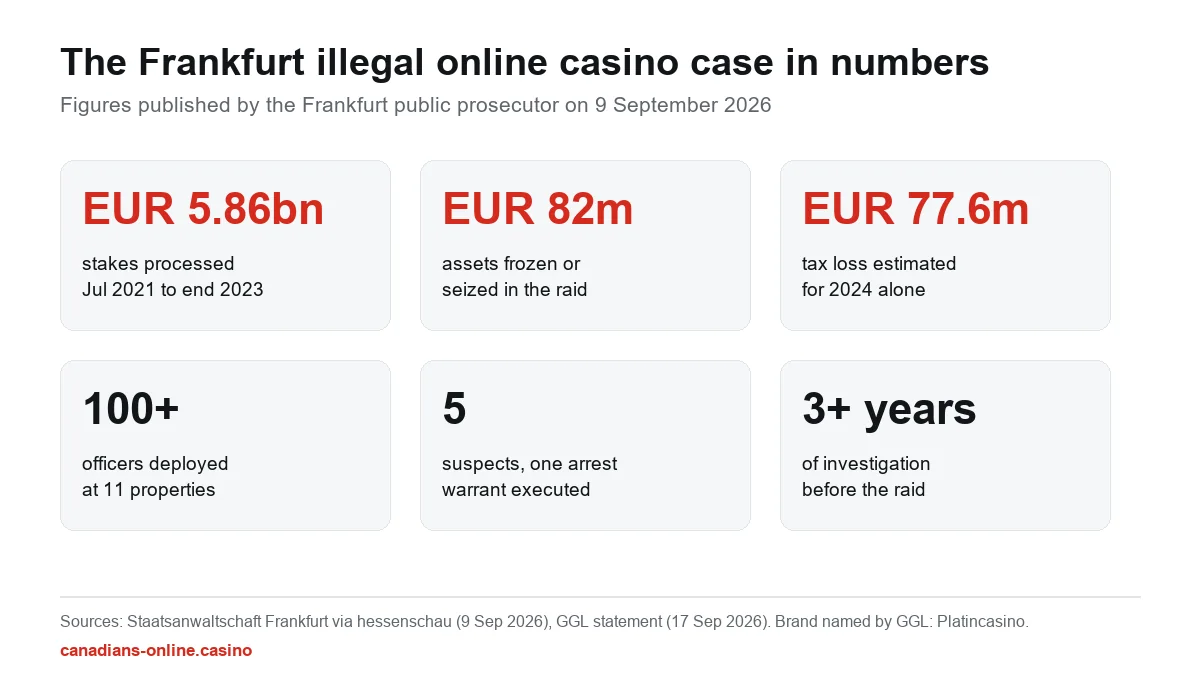
The Frankfurt public prosecutor's office published its summary on 9 September 2026, the day after the operation. The facts it stated, as reported by hessenschau, t-online and the trade press:
- Searches on Tuesday 8 September at 11 properties in Frankfurt, the Rhine-Main region and Cologne.
- More than 100 officers from the prosecutor's office, the Frankfurt tax office, the North Rhine-Westphalia financial crime office and Frankfurt police.
- Five suspects accused of offering commercial online gambling without the required German licence since at least July 2021, with the activity continuing into 2026.
- Stakes of about EUR 5.86 billion processed between July 2021 and the end of 2023.
- Gambling tax paid only partly or not at all; an estimated tax loss of EUR 77.6 million for 2024 alone.
- One arrest warrant executed against the main suspect; an asset restraint order of about EUR 82 million; luxury vehicles seized and bank accounts frozen.
- An investigation that had run for more than three years before the raid.
The prosecutor did not name the platform or any suspect. That matters for what follows: everything about who and what was raided comes from other sources.
How the brand was named
On 17 September 2026 Germany's federal-state gambling regulator, the Gemeinsame Glücksspielbehörde der Länder (GGL), welcomed the operation in a press release and warned consumers "expressly against participating in illegal offers such as Platincasino." The GGL said the case showed the value of cooperation between law enforcement and gambling supervision, and listed the tools it contributes: payment blocking, network blocking and intelligence on operator structures. That release is the only official document that ties the raid to a brand.
A week later a GGL board member, Ronald Benter, used the case to argue that German gambling law changes too slowly and that criminal-law measures against operators targeting Germany from abroad should be strengthened. The regulator's framing, in other words, is that this case is a template, not an exception.
The corporate trail from Malta to Curaçao
The corporate history comes from journalism, not from the prosecutor. In her 22 September story "Wem gehört das Platincasino?" the researcher behind the Curaçao and Malta breaches, Lilith Wittmann, uses Malta Gaming Authority records to reconstruct the structure. According to that story and to reporting by Lovin Malta and Amphora Media:
| Period | Entity | Licence or role | Source of the claim |
|---|---|---|---|
| 2014 onward | Platincasino brand | Website appears, initially serving Germany under the pre-2021 grey-market conditions | Wittmann, citing MGA files and public records |
| 2017 onward | Red Rhino Ltd (Malta) | Malta Gaming Authority licence MGA/CL1/1364/2017 | Wittmann; Lovin Malta; Amphora Media |
| July 2021 | Operator's German licence applications | Not granted under the new State Treaty; continued operation would be unlicensed | Wittmann |
| October 2023 | Latiform B.V. (Curaçao) | Reported to have acquired Platincasino assets for about EUR 6 million | Wittmann, citing internal documents |
| 2023 to 2025 | Curaçao-based operation | Brand continues under Curaçao licensing | Wittmann |
| 8 September 2026 | Frankfurt raid | See above | Staatsanwaltschaft Frankfurt |
The Maltese licence record and the MGA's own files identify an ultimate beneficial owner, and the reporting names him. We do not. German authorities have not identified the arrested person, no charges have been announced, and the person's lawyer has publicly called the accusations baseless. The Malta Gaming Authority, for its part, called the March breach unwarranted and the allegations drawn from it unsubstantiated. Readers who want the name will find it in the sources below; on this site the relevant fact is the structure, not the individual.
The leak, the raid and the timing question
The Curaçao breach began in December 2025. The Malta breach was disclosed in March 2026. The raid happened on 8 September. The stories were published on 22 September. In that order, a popular reading on social media goes: the journalists gave prosecutors the files, the arrest followed, and the "three-year investigation" is a cover story.
The published record does not support it. Three points:
- The prosecutor's own timeline. The Frankfurt office says the investigation ran for more than three years, which puts its start around 2023, two years before the Curaçao portal was accessed and well before the Malta breach.
- The researcher's own account. Wittmann writes that she put her questions to the alleged owner on 28 August 2026, eleven days before the raid, and does not claim her material triggered it. She has said, of the Malta data, that it was shared with "media partners and authorities," which is not the same as saying it started this case.
- The nature of the evidence. A EUR 5.86 billion stakes figure and a EUR 77.6 million tax calculation come from payment records and tax files obtained through German process, not from a regulator's licensing portal. Licensing files show who applied for a licence; they do not show turnover.
What the leak does add is corroboration after the fact. Anyone can now read how the brand moved from Malta to Curaçao and who signed the applications, which is the kind of material that makes a defence of "we were a properly licensed foreign operator" harder to run. That is a real effect, and it is the effect that should worry other operators. It is not the same as the leak causing the arrest.
Why Germany: the 2021 treaty and the grey market
Germany's State Treaty on Gambling (Glücksspielstaatsvertrag) took effect on 1 July 2021 and created a national licence for online slots and poker, with a EUR 1 per spin stake cap, a 5.3 percent tax on stakes, mandatory deposit limits and a central exclusion register. Operators that did not get a licence, or did not want one on those terms, faced a choice: leave the German market or keep serving it from abroad under a Malta or Curaçao licence. Many kept serving it. The GGL, created in 2023, has been building the tools to go after them: IP blocking, payment blocking, and cooperation with prosecutors. The Frankfurt case is the first time those tools have produced a nine-figure asset freeze.
The lesson for the offshore industry is that "licensed in Malta" or "licensed in Curaçao" was never a defence in Germany, only an obstacle to enforcement. The obstacle has now been cleared once, with a method that can be repeated.
What the case signals for offshore operators
- Turnover is the exposure. The charge is offering gambling without a licence; the damages are computed from stakes and unpaid tax. An operator that took EUR 5.86 billion in stakes from one country has a tax exposure in the tens of millions before any fine.
- Corporate relocation does not reset the clock. Moving the brand from a Maltese company to a Curaçao company in 2023 did not stop a case that started in 2023 and covered 2021 onward.
- Owners, not shells, get raided. The properties searched were in Germany, where the alleged owner lived. Licensing files, once public, make it straightforward to connect a shell to a person and a person to an address.
- Regulators now have the data set. With both the Malta and Curaçao files in circulation, every regulator with a grey-market enforcement mandate can build the same map. Germany has said publicly that it wants to move faster.
The Canadian parallel
Canada has two regulated online markets, Ontario since April 2022 and Alberta since 13 July 2026, and both were modelled in part on the European approach of licensing private operators and then squeezing the unlicensed ones out. Ontario has so far used the softer tools: it required operators to choose between the Ontario licence and the grey market, and most large brands chose the licence. There has been no Frankfurt-style raid in Canada, and the Criminal Code treatment of offshore operators is less clear-cut than Germany's, so a direct equivalent is unlikely in the near term.
The parallel that does hold is on the operator side. A casino that takes Ontario players without an Ontario licence is doing exactly what Platincasino is accused of doing in Germany: serving a regulated market from an offshore licence. If you play in Ontario or Alberta, the safest reading of this case is that offshore operators serving your province are the ones with the most to lose, and that their withdrawals, support and terms will be the first things to deteriorate when pressure arrives. Our guide to verifying a Curaçao licence covers the checks, and our explainer on the Curaçao leak covers the wider story. If a payout is already stuck, our free player help desk is the place to start.
Sources
- hessenschau: Fast sechs Milliarden Euro mit illegalem Online-Glücksspiel umgesetzt (9 September 2026)
- GGL: GGL begrüßt erfolgreichen Schlag gegen illegales Glücksspiel in Milliardenhöhe (17 September 2026)
- Gambling News: Germany raids suspected illegal gambling network (11 September 2026)
- Lilith Wittmann: Wem gehört das Platincasino? (22 September 2026)
- Lovin Malta: Hacked MGA files point to Malta in Germany's biggest illegal casino case (23 September 2026)
- Amphora Media: MGA-licensed operator linked to EUR 5.86 billion German illegal gambling probe (September 2026)
- Well Played: German police raid illegal gambling ring that handled almost EUR 6bn (September 2026)
The short version
The Platincasino case is a German tax-and-licensing prosecution built over three years, not a product of the Curaçao leak, and the two should be kept apart when reading about either. What the leak adds is a public map of how an offshore brand moved between licences, and that map is now available to every regulator that wants one. For Canadian players the practical takeaway is modest: an offshore licence protects the operator from nothing once a regulated market decides to enforce, and the first casualties of that pressure are the players' withdrawals. Keep balances low at offshore sites, verify the licence, and in Ontario and Alberta, play locally.
About the editorial team. Our editorial team tests online casinos for Canadian players and helps them when a payout goes missing. Every casino listed on this site has been signed up for, deposited to and cashed out of with our own money. Corrections and reader experiences: see our about page.
Frequently asked questions
What happened in the Frankfurt raid on 8 September 2026?
More than 100 officers searched 11 properties around Frankfurt and Cologne, executed one arrest warrant and froze about EUR 82 million in assets. Prosecutors say five suspects offered online gambling without a German licence and processed EUR 5.86 billion in stakes between July 2021 and the end of 2023.
Who named Platincasino?
Germany's gambling regulator, the GGL, in a press release on 17 September 2026 warning consumers against illegal offers such as Platincasino. The prosecutor's own summary named neither the platform nor the suspects.
Was the raid caused by the Curaçao or Malta leak?
No published evidence supports that. Prosecutors describe a three-year investigation, and the researcher behind the leaks does not claim her material triggered the raid. The leaked files corroborate the corporate structure after the fact.
Why was Platincasino illegal in Germany if it had a Malta licence?
Germany's 2021 State Treaty requires a German licence for online slots. A Malta or Curaçao licence does not satisfy that requirement, so serving German players without a German licence is treated as illegal gambling regardless of the foreign licence.
Could something similar happen in Canada?
Ontario and Alberta have regulated markets and can act against unlicensed operators, but Canada has no enforcement program comparable to Germany's, and no comparable raid has taken place. The practical risk for Canadian players is on the operator side: withdrawals and support at pressured offshore sites tend to deteriorate first.
Has anyone been charged?
As of 24 September 2026, one arrest warrant has been executed and no charges have been announced. The arrested person's lawyer has called the accusations baseless.